Foundational technologies, built from first principles.
We identify critical infrastructure problems where legacy approaches have become bottlenecks and solve them at the algorithmic level, engineered for modern silicon.
Where we are today
JavaScript SDK for MapLibre
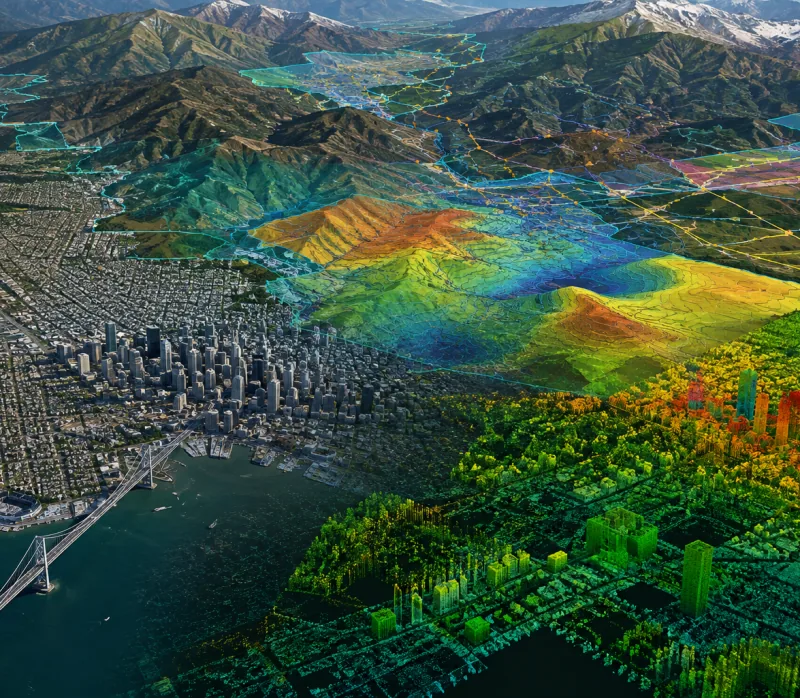
Splats, LiDAR point clouds, meshes, elevation and imagery decoded in the browser as an ordinary MapLibre layer, with OGC 3D Tiles and Esri I3S streaming. No build step.
@bitruvius/sdk-maplibre v0.3.3
Developer Hub8 Turbo drop-in codecs
Memory-safe, wire-compatible replacements for the C libraries customers already run. Shipping now to beta testers.
Spatial Engine
The first application on the codecs: converts and reprojects geospatial imagery into the same GeoTIFF, COG and MRF files as GDAL, faster and in a fraction of the memory.
See the benchmarks2 flagship codecs
RIPT for scientific rasters and BVC for point clouds and Gaussian splats: new formats, not drop-ins, where the compression lift is structural. Both patent pending.
Test partners
and VC investors.
Test partners to run the Turbo and Spatial Engine betas against real pipelines, and venture investors to take the suite to market.
Test partners we want
Hyperscalers
Storage and compute at petabyte scale
Academic Research
Scientific archives and HPC pipelines
Imagery Collectors
Satellite, aerial and radar operators
Enterprise Geospatial Software
Platforms with imagery at their core
The Opportunity
Data is exploding.
Infrastructure hasn't kept up.
satellite constellation
Earth science archive
archival market
Legacy compression was designed for hardware that no longer exists. Organizations are forced to choose between fast processing and efficient compression. They need both.
And it goes deeper than the codecs. The rails every spatial pipeline runs on, the infrastructure that converts, reprojects and serves imagery, were built for the same old hardware. We're rebuilding the foundation: the codecs and the rails on top of them.
The Suite: ten codecs, one substrate
RIPT and BVC, plus eight drop-ins.
Two flagship codecs, both patent-pending and coming soon to private beta, will ship as licensed, compiled
binaries through the Developer Hub.
Eight memory-safe drop-ins, now shipping to beta
testers, replace the C library a customer already runs. They are wire-compatible, so they swap
in with no migration. That compresses a pilot from multiple quarters to 2-6 weeks, and each one
is a route into the flagship codecs.
See the suite overview.
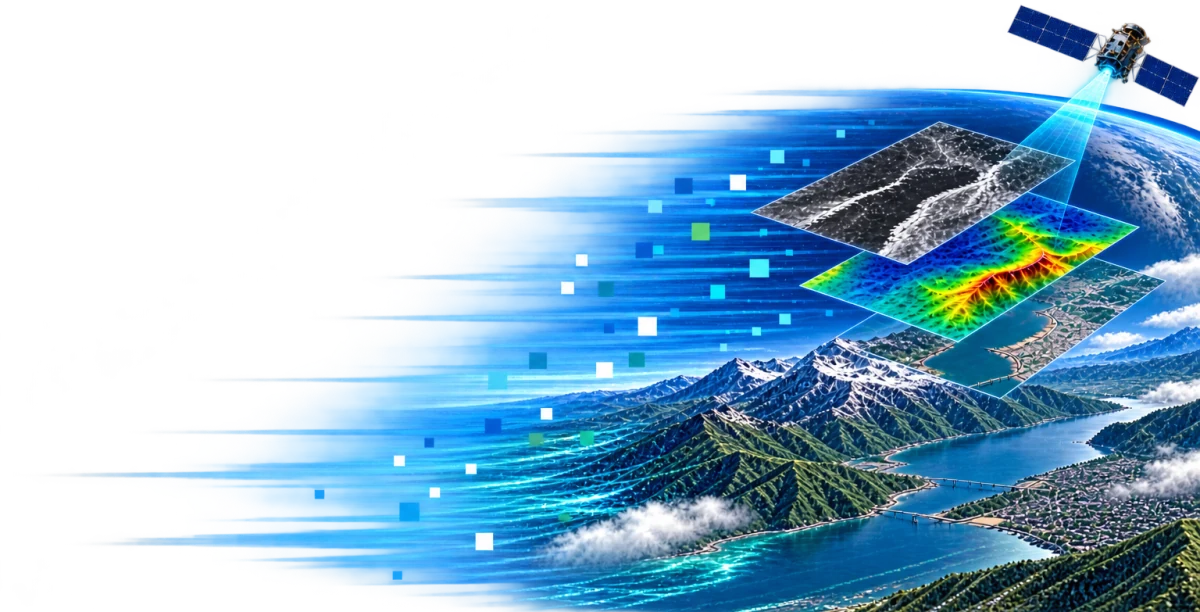
A new codec
Adaptive predictive tiling. Wins on prediction-friendly data and on lossy modes. Targets new deployments where buyers control both encoder and decoder.
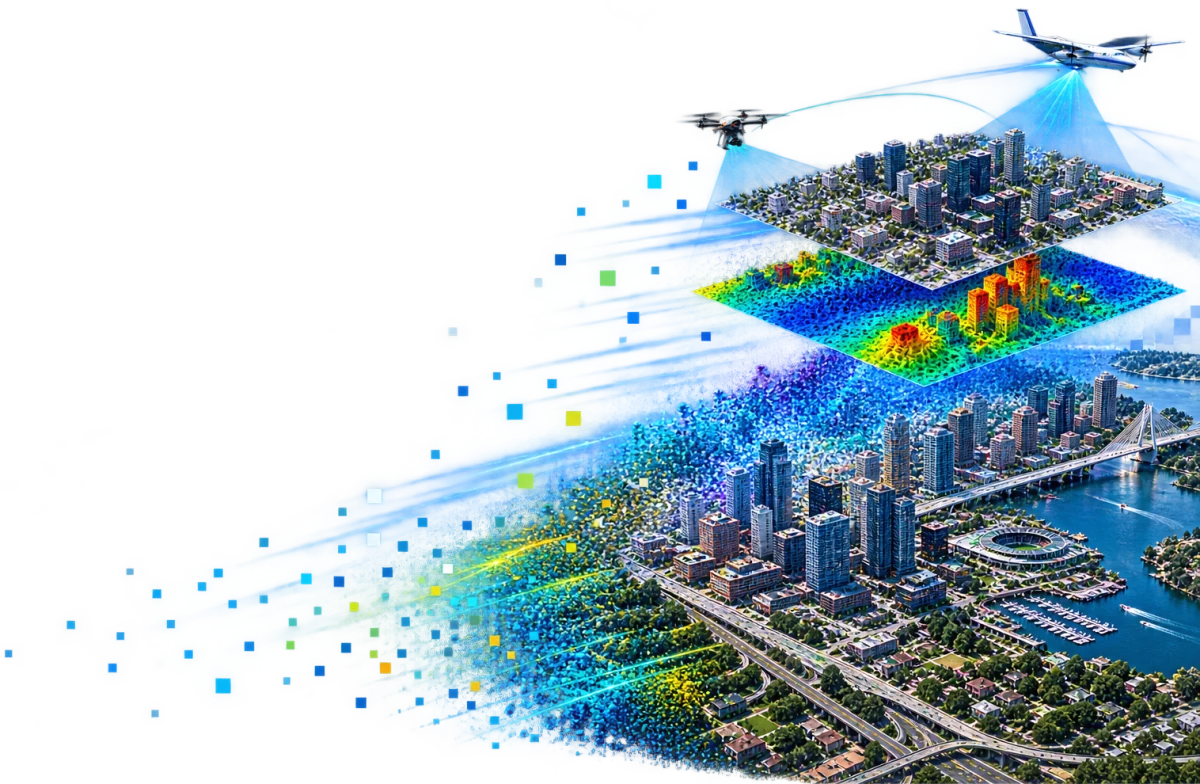
A new codec, volumetric
Bitruvius Volumetric Codec, one codec for lidar point clouds and Gaussian splats. Lossless files smaller than the incumbents' lossy ones, decoded at GPU speed.
Plus the full Track B drop-in lineup
2.80× faster writes, 1.74× faster reads; faster both ways on all 392 files
2.9× faster encode at defaults for 2.9% more bytes, 4.5× at max effort; decode faster in 47/64 tests
1.8×–4.5× faster writes and 3.5×–5.0× faster reads per core, at libjxl's own effort
2.10× faster reads on real imagery, writes faster in 12/12 tests
Reads faster at every setting (up to 1.16×), 1.38× faster at high-compression level 1, size within ±0.03%
Reads 1.73×–2.07× faster at every level; 3.65× faster archival writes on one core, 19.4× on every core
Faster in 21 of 24 single-core tests; 14.4× faster bulk encode
4–7× faster writes at the default (5.7–7.2% larger), or 3.1–3.5% smaller and still 1.6× faster; 1.3–1.8× faster in the browser
Headline figures as published on each product page, measured against the upstream library named. Methods and full boards are on the suite pages.
The products tell different stories. RIPT is a new codec with its own output; its compression varies by domain, with prediction-friendly data delivering 6×–20× lossless on high-res LiDAR and lossy modes pushing past 200× on flat high-res LiDAR DEM; basemap-resolution DEM and bathymetry compress orders of magnitude further (≈1,500–6,000× lossless). TurboLERC writes the same LERC files Esri's library does and is faster both ways on all 392 files measured, with 99% of files the same size or smaller. RIPT figures are from the benchmark corpus dated 2026-05-16; TurboLERC figures from its newest captures, dated 2026-06-06 (Intel) and 2026-04-27 (Apple silicon).
The Numbers
Backed by data.
Solid bar = median across the matched corpus.Faded bar = 90th percentile (clipped to chart bounds when extreme outliers stretch beyond).
Solid bar = median across the matched corpus.
Spatial Engine: the first application on the rails
Rails for next-generation
spatial infrastructure.




Starting with Spatial Engine. It reads, converts and reprojects satellite, aerial, radar and elevation imagery, writing the same GeoTIFF, COG and MRF files as GDAL, faster and in a fraction of the memory. Now in private beta.
See Spatial Engine →Against GDAL 3.13.3 on Windows x64 and Apple silicon, across imagery from ICEYE, Planet and USGS. Write once: GDAL finished first in 3 of 8,452 runs. Read forever: 10 of 7,648. Method and full results on the Spatial Engine page.
Market Opportunity
Any industry that stores
grids of numbers.

Satellite & Remote Sensing
30+ TB/day capture rates, petabyte-scale archives
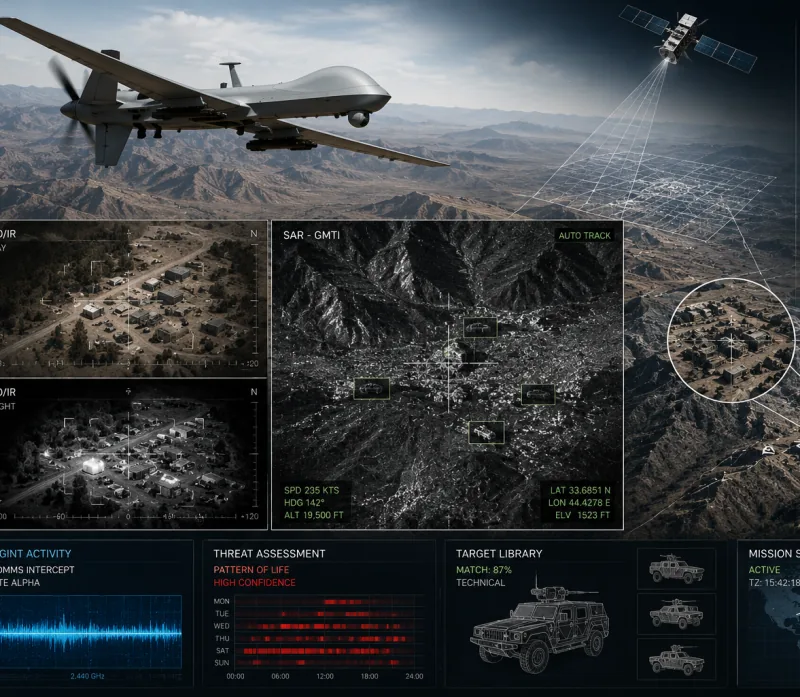
Defense & Intelligence
Classified imagery, real-time ISR, tactical edge compute
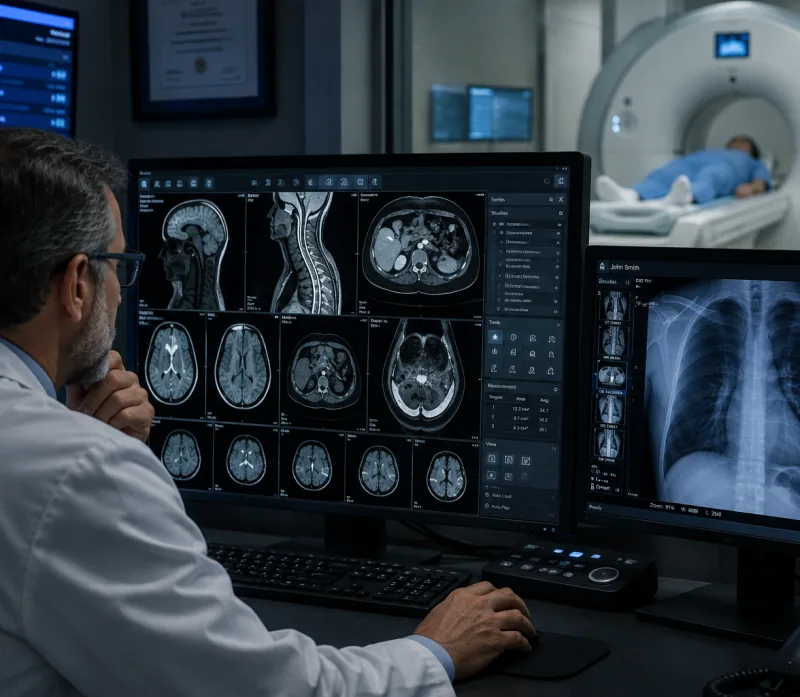
Medical Imaging
$4.2B PACS market, CT/MRI/pathology archives
Geospatial & Mapping
Elevation models, LiDAR, Cloud Optimized GeoTIFF

AI/ML Infrastructure
Native int4/bf16 support, training data pipelines

Cloud & Scientific Computing
Storage egress reduction, HPC data movement
Technical Moat
Designed for how processors
actually work.
SIMD-First Architecture
Every predictor and transform operates on multiple pixels per instruction, exploiting the full width of modern processors. Not an optimization layer. The foundation.
Per-Tile Adaptive Selection
Instead of applying one strategy everywhere, RIPT independently picks the best predictor for each tile from an extensible library. Different data, different strategy. Automatically.
Cross-Platform Bit-Exact
Bit-exact identical output across NEON, AVX2, and the scalar fallback today. AVX-512 and SVE2 dispatch lands with benchmarks in Q1 2027. No prior scientific raster codec offers this guarantee.
Cache-Aligned Processing
Tiles are sized to fit in L1 cache. Zero-copy data paths. Every byte movement is intentional.
Defensibility
A three-layer moat.
Patents pending
Provisional patent filings cover the native Bitruvius formats: the RIPT adaptive tile-based system with its novel predictors, and the BVC volumetric codec for point clouds and Gaussian splats.
Compiled-only distribution
Both products ship exclusively as compiled binaries via the Bitruvius Developer Hub, including for paid licensees. The algorithm never enters source form on customer machines, materially raising the cost of reverse engineering.
Cross-platform SIMD substrate
A vendor-neutral dispatch layer covering NEON, AVX2, and scalar fallback today, with AVX-512 and SVE2 lined up for Q1 2027. Years of low-level engineering an open-source competitor would need to reproduce before they could even start matching feature parity.
Go-to-Market
Business Model
Free SDK, licensed codecs
The JavaScript SDK for MapLibre is free, putting the formats in front of every MapLibre developer. Production codec licenses are paid: per-seat, per-transaction, OEM, and enterprise tiers, compiled binaries via the Developer Hub.
Standards integration
Drop-in LERC replacement (via turbolerc), GDAL driver, Cloud Optimized GeoTIFF support, DICOM compatibility. Designed to slot into existing workflows without migration pain.
Interested in
learning more?
The JavaScript SDK for MapLibre is available today and free to use. The eight Turbo drop-ins are in beta, and RIPT and BVC are next. We're raising our seed round from venture investors to bring the flagship codecs to market, and we're looking for test partners to run the beta against real pipelines.