
Hello, world. Bitruvius is live.
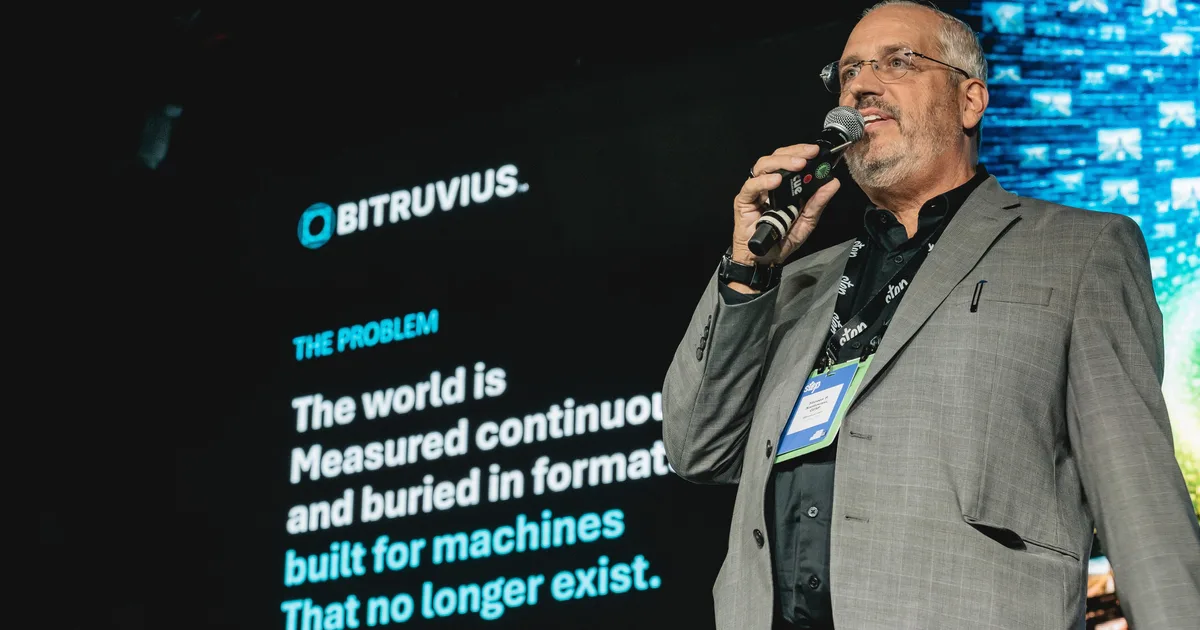
We rebuild foundational data infrastructure for geospatial, imagery, and 3D: from first principles, engineered for modern silicon. This is our first post, so it should do what a first post is for. Tell you who we are, what we are building, and why we think it matters enough to build a company around.
Why we exist
Anyone working with geospatial, scientific, or 3D data runs into the same gap eventually. The datasets grew. The networks grew. The GPUs grew. The formats sitting between them mostly did not. Teams pay for that gap three times over: in storage, in transfer, and in the compute spent unpacking data into something usable.
That gap is not a missing feature. It is missing substrate. The formats this industry runs on were designed for a different era of hardware, and every pipeline built on top of them inherits the ceiling. We started Bitruvius to raise it.
Who we are
Between us we have spent careers in geospatial, imagery, and remote sensing: shipping enterprise and government platforms, architecting solutions and SDKs, building big-data and AI/ML pipelines, and taking products from concept to global launch. Few teams have worked hands-on with as broad a range of 3D, imagery, and remote-sensing clients and use cases as we have.
We kept wishing the substrate underneath all of that work was better. Now we are building it.
What we are building
One suite. Every format that matters. The Imagery & 3D Suite is ten codecs behind one design philosophy: RIPT and BVC, our native patent-pending formats for raster and volumetric data, plus eight drop-in codecs for imagery, elevation, point clouds, Gaussian splats, and general-purpose compression.
Every codec shares the same contract. Decoders are free everywhere, so the ecosystem can adopt our formats without friction. Encoding ships through the Developer Hub. Every design decision is backed by benchmarks: we profile before optimizing, test against real data, and let the numbers settle debates. And correctness is non-negotiable. In lossless mode, every decoded value matches the original exactly. In lossy mode, error bounds are guaranteed. There is no “close enough” without a contract.
And you do not have to take our word for any of it. The image and 3D codecs we build run live on this site, in your browser, on your hardware. Head to RIPT and BVC, race them against the formats you use today, and see the performance for yourself. Real data, real numbers, nothing to install.
What this blog is for
The product pages explain what each codec does, and the documentation lives with each product. This blog is for everything that context strips away: why we made the bets we made, what we learn as the suite meets real workloads, and where this industry is heading as datasets grow faster than the systems built to serve them.
Posts come from the people doing the work. Nobody here writes for a living, which we consider a feature. We will not publish on a fixed schedule: when we have something worth your time, we will write it down.
Follow along
This is day one, and the honest version of a launch announcement is an invitation. Subscribe to the newsletter from any page on the site, or add the RSS feed to your reader and let the posts come to you.
And if you work with imagery, point clouds, or 3D data and these problems sound familiar, we would like to hear from you: what you are shipping, what is slowing it down, and what you would build on a better substrate. Talk to us.
Welcome. We are glad you are here.